

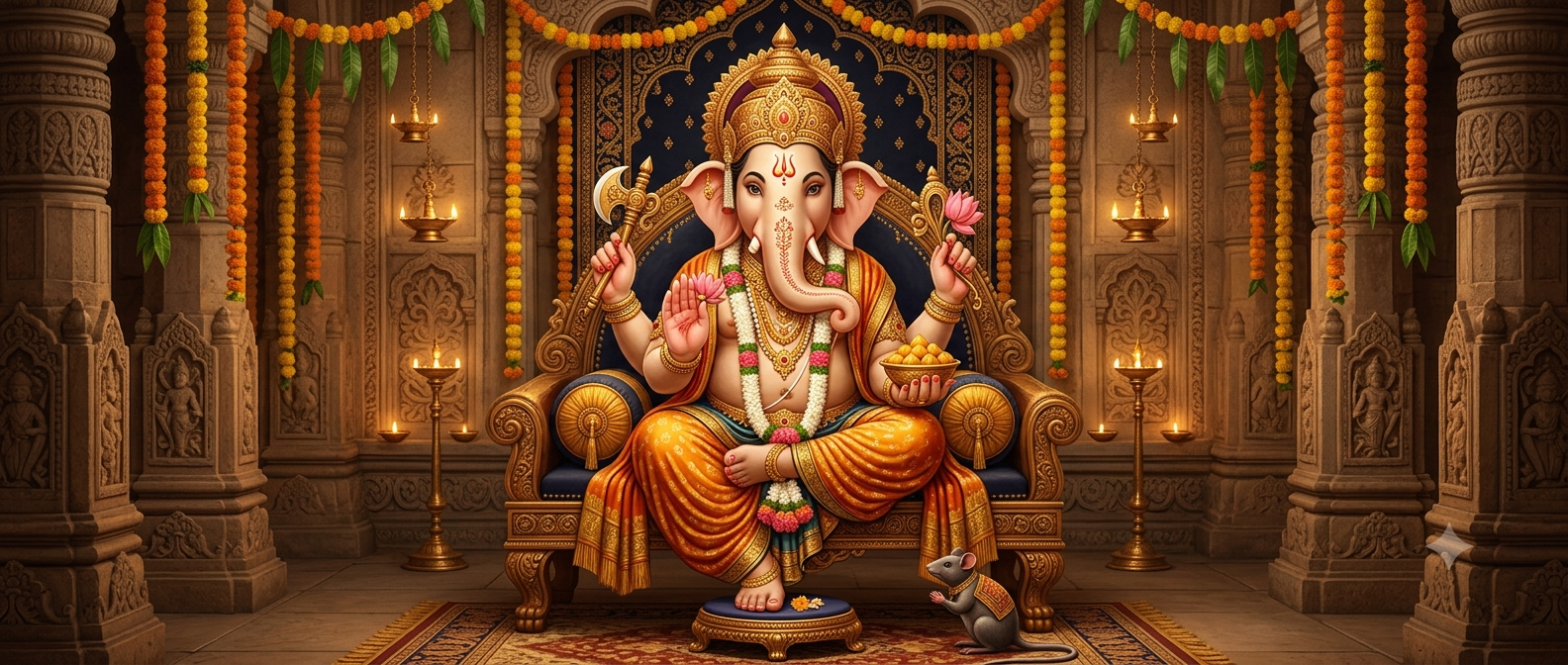
Before a wedding, before a new business, before the first page of a ledger is marked, or the foundation stone of a house is laid, millions across Bharat pause to invoke one name: Ganpati.
Known interchangeably as Ganesha, Vinayaka, Gajanana, and by a hundred other names, this elephant-headed deity occupies a unique space in the Hindu tradition. He is Prathama Pujya—the one who must be worshipped first.
This article explores who Ganpati is within the living tradition: his scriptural foundations, the deep metaphorical meaning carried in his form, his beloved origin stories, and the grand public history of the Ganesh Chaturthi festival.
Who is Ganpati?
In Hindu theology, Ganesha is the son of Shiva and Parvati. His primary name is derived from the Sanskrit roots gana (host or multitude) and isha (lord), designating him as the leader of Shiva’s celestial attendants. This role and his divine attributes are heavily detailed in the Ganesha Purana and the Mudgala Purana, the primary texts dedicated to his worship.
While the specific, elephant-headed form of Ganesha crystallized in later centuries, the title “Ganpati” finds its earliest roots in ancient Vedic literature. The Rigveda (2.23.1) features the famous invocation:
“Gaṇānāṃ tvā gaṇapatiṃ havāmahe…” (We invoke you, O Lord of the hosts…)
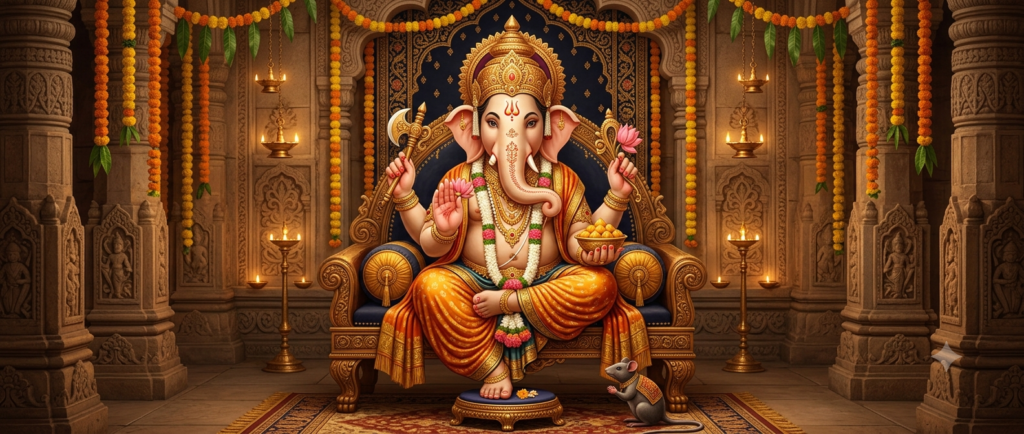
Though originally associated with Brihaspati (the preceptor of the gods), this Vedic mantle of supreme wisdom and guardianship was seamlessly integrated into Ganesha’s identity as the deity of new beginnings.
Today, his worship cuts across regional, linguistic, and sectarian lines. He is globally honored as Vighnaharta (the remover of obstacles), appearing at the thresholds of temples, the headings of formal ceremonies, and the opening pages of financial accounts.
The Metaphorical Meaning Held in His Form
Ganpati’s iconography is among the most symbolically rich in global religious art. In the devotional and commentarial tradition, such as the Ganesha Gita, every physical feature is understood to carry a profound spiritual or practical lesson.
Renowned scholar Paul B. Courtright, in his definitive academic study “Gāṇeśa: Lord of Obstacles, Lord of Beginnings”, notes that Ganesha’s form serves as a visual bridge between the human and the divine. Traditional interpretations include:
- The Elephant Head & Large Ears: Symbols of supreme intellect, discernment, and the immense value of listening deeply (shravana) before acting.
- The Single Tusk (Ekadanta): Associated with sacrifice and the philosophical idea of non-duality—retaining the essential truth while casting away the non-essential.
- The Large Belly: Symbolizes the capacity to peacefully digest all of life’s experiences, both the bitter and the sweet.
- The Mouse (Mushaka): Representing desire or the restless human mind—small, destructive if left unchecked, but completely mastered by the deity who rides it.
- The Modaka (Sweet Dumpling): Represents the ultimate reward of a life rooted in wisdom, discipline, and spiritual pursuit.
The Stories of His Origin
Several beloved accounts of Ganesha’s origin appear across Puranic literature. Rather than enforcing a single, rigid historical chronicle, the Hindu tradition has long embraced these varied narratives for their underlying theological truths.
The Shiva Purana Account
The most widely known narrative comes from the Shiva Purana (Rudra-samhita, Kumara Khanda). It tells of Goddess Parvati creating a young boy from the turmeric paste of her own body to guard her door while she bathed. When Shiva returned and was barred entry by the boy, a fierce conflict ensued, resulting in the boy being beheaded. To appease the grief-stricken Parvati, Shiva restored the child to life by attaching the head of an elephant, granting him the foremost status among all gods.
The Brahma-vaivarta Purana Variant
Conversely, the Brahma-vaivarta Purana (Ganapati Khanda) offers an entirely different perspective. Here, Ganesha is born as a beautiful child through Parvati’s intense ascetic devotion. However, when the planet-god Shani (Saturn) comes to gaze upon the newborn, his powerful, destructive glance accidentally turns the infant’s head to ashes. Vishnu then intervenes, riding to the riverbanks to find a suitable replacement head, returning with that of a young elephant.
Historical Context
From a historical and academic viewpoint, Indologists such as Gavin Flood (An Introduction to Hinduism) note that while references to Vinayakas (obstacle-creating and removing spirits) exist in earlier texts, the fully formed, benevolent deity we recognize today was formally codified in Puranic literature from the 5th and 6th centuries CE onward.
A Note on Sacred Narrative: These Puranic accounts are received as sacred living tradition. In cultural analysis, we deliberately distinguish devotional narratives—which convey timeless moral and metaphysical values—from documented archaeological or historical records.
Ganesh Chaturthi: The Great Public Festival
Ganpati’s worship reaches its most vibrant expression during Ganesh Chaturthi, the festival marking his birth. While celebrated in homes across the world, its grand public manifestation is deeply tied to the cultural history of western and southern Bharat—specifically Maharashtra and Goa.
The modern, public format of the festival (Sarvajanik Ganeshotsav) is a direct legacy of the late 19th century. In 1893, the Indian nationalist leader Lokmanya Bal Gangadhar Tilak revolutionized the festival, transforming it from a private household ritual into a massive community event.
As historian Richard Cashman details in “The Myth of the Lokamanya”, Tilak strategically used the festival to bypass the British colonial government’s strict anti-public assembly laws. Because the British administration could not easily ban religious gatherings without causing a massive civil revolt, Ganesh Chaturthi became a vital, safe space for community building, national education, and anti-colonial organizing.
This historic transition from a private faith ritual to a platform for social solidarity is extensively documented by cultural institutions globally, including historical archives preserved by the Denver Art Museum.
Why Ganpati Endures
Part of Ganpati’s eternal appeal lies in his immense accessibility. He is profoundly human in his divine attributes—fond of sweets, easily approachable, and close to the everyday concerns of ordinary people.
He is rarely invoked for distant, abstract salvation; rather, he is sought for the immediate, practical human business of beginning well. Whether a student is sitting for an examination, an entrepreneur is launching a venture, or a family is stepping into a new home, Ganpati is there to clear the path.
In a civilization that places immense spiritual weight on auspicious beginnings, the Lord of Beginnings remains deeply, universally beloved. To invoke Ganpati is to step forward into the unknown with confidence, grounded in the comforting belief that with wisdom, all obstacles can be overcome.
References & Further Reading
- Cashman, Richard I. (1975). The Myth of the Lokamanya: Tilak and Mass Politics in Maharashtra. University of California Press.
- Courtright, Paul B. (1985). Gāṇeśa: Lord of Obstacles, Lord of Beginnings. Oxford University Press.
- Flood, Gavin D. (1996). An Introduction to Hinduism. Cambridge University Press.
- The Rigveda (Mandala 2, Hymn 23, Verse 1).
- The Shiva Purana (Rudra-samhita, Kumara Khanda, Chapters 13–18).
- The Brahma-vaivarta Purana (Ganapati Khanda).
- Denver Art Museum. Ganesha: The Playful Protector (Educational & Curatorial Archives).


Leave a comment